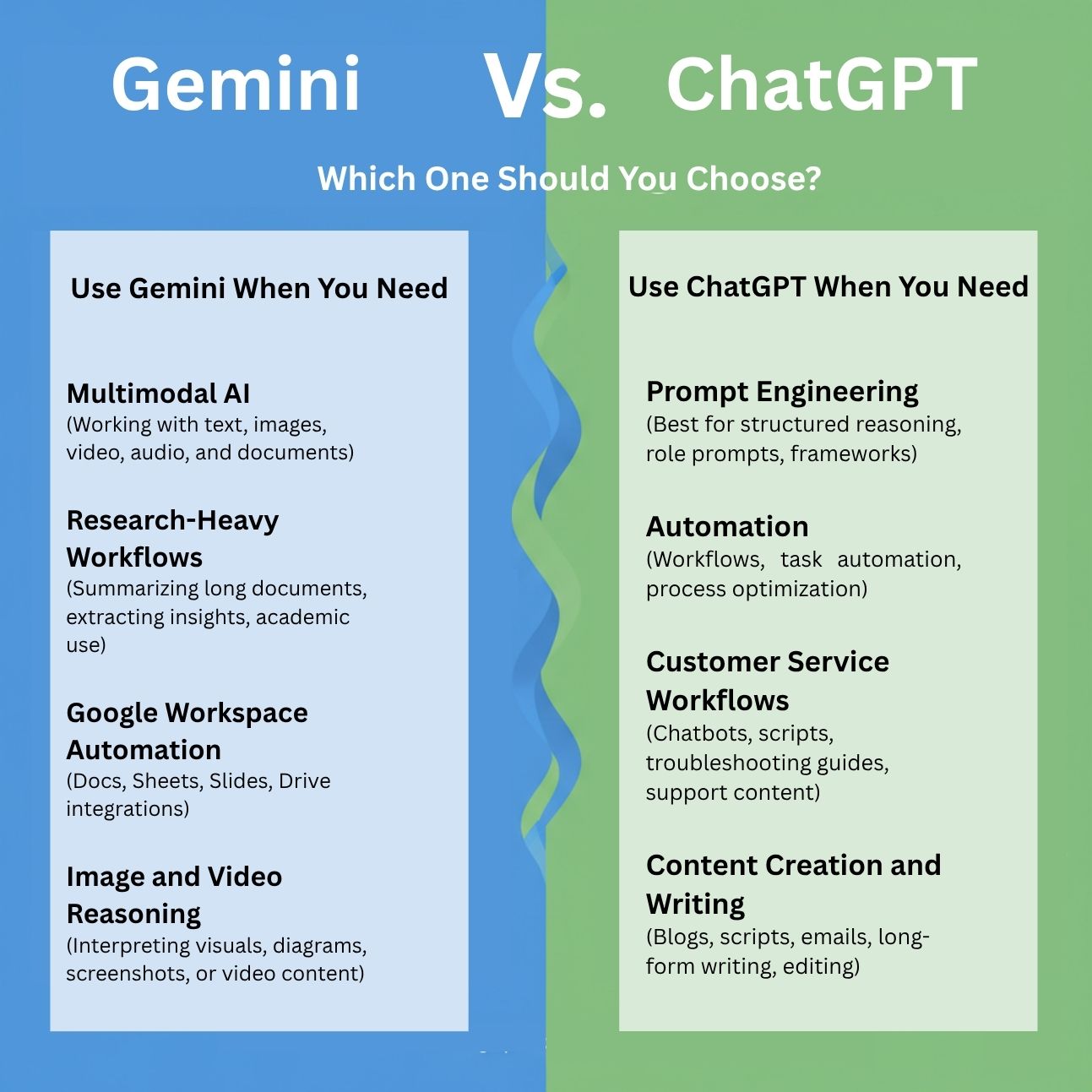
In 2026, the ChatGPT vs Google Gemini debate is no longer just about which chatbot gives the cleverest answer. It is about which assistant fits into your daily workflow, your study habits, your research process, your creative projects, and your budget.
The hype around Gemini has grown because many users now see it as more than a chatbot: it is tied closely to Google Search, Gmail, Docs, Drive, Android, and YouTube. ChatGPT still has major strengths, especially for writing, reasoning, prompt-based creativity, and custom workflows, but the gap has changed.
| Category | ChatGPT | Google Gemini |
|---|---|---|
| Best For | Writing, brainstorming, coding help, structured workflows, creative prompts | Research, studying, Google ecosystem tasks, real-world information lookup |
| Everyday Use | Excellent as a general AI workspace with strong conversation quality | Excellent if you already use Google Search, Gmail, Docs, Drive, or Android |
| Free Version | Useful, but some advanced features may depend on plan and availability | Very competitive for casual users, especially for Google-connected tasks |
| Biggest Weakness | Can feel less integrated with your existing files and web habits | Can be less consistent for polished long-form writing and creative control |
If you want a broader breakdown of the two tools, see Gemini vs ChatGPT: The Complete Breakdown Before You Pick One. For a more everyday-assistant angle, you can also read ChatGPT vs Gemini: Which AI Is the Better Everyday Assistant in 2026?.
ChatGPT — What It Does Best
ChatGPT remains one of the strongest AI tools for turning vague ideas into usable output. If you need a blog outline, a sales email, a resume rewrite, a coding explanation, a product description, or a step-by-step plan, ChatGPT is still extremely reliable.
Its biggest advantage is structured generation. ChatGPT is very good at taking a messy request and producing something organized. It can create tables, frameworks, scripts, checklists, lesson plans, and polished drafts with a clear tone.
For writers, marketers, students, creators, and solo professionals, this matters. Gemini can write well, but ChatGPT often feels more controllable when you want a specific voice, format, or creative direction. If you are building content systems, prompt libraries, or repeatable templates, ChatGPT is usually easier to shape.
ChatGPT is also strong for creative prompting. People using AI for image prompts, video concepts, captions, fictional scenes, ad angles, or social media ideas often prefer ChatGPT’s ability to expand a short idea into multiple usable variations. For example, if you are experimenting with visual prompts, this guide on 5 Viral ChatGPT Prompts for IPL 2026 Stadium Photos and Reels shows the kind of prompt-first workflow where ChatGPT still shines.
The weakness is that ChatGPT can sometimes feel like a separate workspace rather than an assistant living inside your daily tools. If your work is spread across Gmail, Google Docs, Drive, Calendar, YouTube, and Search, Gemini has a natural advantage. ChatGPT can still help, but the handoff often requires more copying, pasting, uploading, or setup.
Another issue is perception. Some users feel ChatGPT has become less consistent at times, especially compared with newer Gemini releases. That does not mean ChatGPT is weak; it means its biggest strength is no longer being “the obvious best at everything.” In 2026, ChatGPT is best when you need high-quality output creation, not necessarily the deepest ecosystem integration.
Google Gemini — What It Does Best
Google Gemini’s biggest win is simple: it fits naturally into how many people already use the internet. If your day starts with Google Search, continues in Gmail or Docs, and ends with YouTube or Drive, Gemini feels less like a separate AI app and more like an extension of your existing workflow.
Gemini is especially strong for research and information-heavy tasks. When you are comparing products, summarizing a topic, studying a subject, planning travel, checking sources, or trying to understand current information, Gemini’s Google connection gives it an advantage. It is not just answering; it often feels closer to a research companion.
For students, this is a major reason Gemini has become popular. It can help explain concepts, summarize long material, create study plans, generate quizzes, and connect topics to real-world examples. ChatGPT can do these things too, but Gemini’s strength is in helping you move between question, source, summary, and follow-up faster.
Gemini also benefits from Google’s broader ecosystem. If you are on Android, using Google Workspace, or relying on Drive and Docs, the convenience factor becomes hard to ignore. In a practical comparison, convenience is not a small detail. The AI you use most is usually the one that appears where your work already happens.
Gemini’s weakness is creative precision. It can produce good writing, but if you want a very specific brand voice, a more persuasive landing page, a fiction scene with personality, or a tightly formatted content asset, ChatGPT often requires fewer corrections. Gemini is excellent at finding, explaining, and connecting information; ChatGPT is often better at packaging that information into a polished final product.
Another weakness is that Gemini can sometimes feel more “Google-like” than “writer-like.” That is useful for research, but not always ideal for storytelling, emotional tone, or highly stylized content. If your main goal is output quality rather than information access, ChatGPT remains a serious competitor.
Which Should YOU Choose?
If you are on a budget: choose Google Gemini first. Its free experience is strong for everyday questions, studying, quick research, and Google-connected tasks. If you only want one free AI assistant for general use, Gemini is the better starting point in 2026.
If you are a power user: choose ChatGPT if your work depends on repeatable prompts, content creation, coding support, long planning sessions, or custom workflows. Choose Gemini if your power use is research-heavy and tied to Google Workspace. For many professionals, the best setup is Gemini for research and ChatGPT for final drafting.
If you are a beginner: choose Gemini. It is easier to understand because it aligns with familiar Google habits. You ask a question, research a topic, summarize information, and move into Docs or Gmail without feeling like you are learning a new productivity system.
If you are a student: Gemini wins for studying in most cases. It is strong for explanations, summaries, research, and connecting topics. ChatGPT is better when you need essay structure, practice answers, flashcard formatting, or a polished final draft.
If you are a writer or creator: ChatGPT wins. It is better for tone control, ideation, hooks, outlines, scripts, captions, and creative variations. Gemini can help with facts and research, but ChatGPT is usually better when the final output needs personality.
If you are comparing ChatGPT, Gemini, and Copilot: Gemini is best for Google users, Copilot is best for Microsoft 365 users, and ChatGPT is best as a flexible standalone AI workspace. Your existing ecosystem matters more than most benchmark comparisons.
Final Verdict: Google Gemini Wins for Most People in 2026
The clear winner for most everyday users is Google Gemini. The reason is not that it beats ChatGPT in every category. It does not. ChatGPT is still better for many writing, creative, and workflow-heavy tasks.
But the question is which AI should be your default assistant in 2026. For that, Gemini has the stronger case because it is more naturally connected to search, studying, documents, email, Android, and the way many people already work online.
Choose Google Gemini if you want one AI for daily research, studying, quick answers, Google apps, and general productivity. Choose ChatGPT if you care most about polished writing, creative control, prompt engineering, and building repeatable AI workflows.
Overall recommendation: Gemini is the better default assistant in 2026, while ChatGPT is the better specialist for creators, writers, and advanced prompt users.
FAQ
Which is better, ChatGPT or Gemini, for studying?
Gemini is better for studying if you want explanations, summaries, research help, and quick movement between sources. ChatGPT is better for turning study material into essays, outlines, quizzes, flashcards, and polished revision notes.
Is ChatGPT or Gemini better for writing?
ChatGPT is better for writing, especially when tone, structure, persuasion, or creativity matters. Gemini can write well, but ChatGPT usually gives more controllable drafts and stronger creative variations.
Which free version is better in 2026?
Gemini has the stronger free experience for most casual users, especially for everyday search-style questions and Google ecosystem tasks. ChatGPT’s free version is still useful, but its biggest advantages are more noticeable for users who rely on advanced writing or workflow features.
Should I use ChatGPT, Gemini, or Copilot?
Use Gemini if you live in Google apps, Copilot if your work is built around Microsoft 365, and ChatGPT if you want the most flexible standalone AI for writing, brainstorming, coding help, and creative projects.
“Use Gemini if you live in Google apps, Copilot if your work is built around Microsoft 365, and ChatGPT if you want the most flexible standalone AI for writing, brainstorming, coding help, and creative projects.”

*Affiliate link — we may earn a small commission at no extra cost to you.

Career growth columnist and industry observer. Writes about salary negotiations, job market trends, and upskilling for India's emerging workforce.