
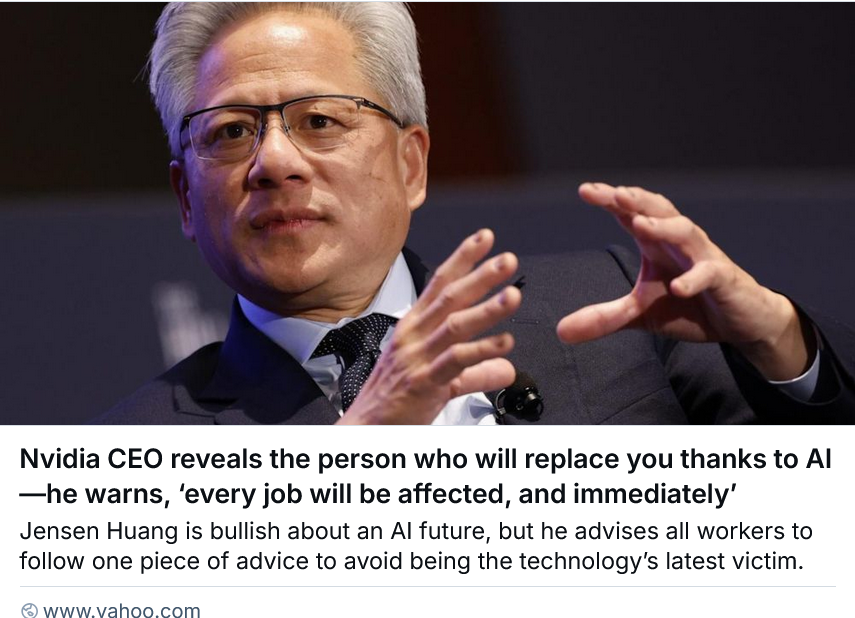
Many workers are asking the same quiet question: “Will my job still matter if tools keep getting smarter?” The surprise is that Nvidia CEO Jensen Huang’s message is not about panic. It is about learning faster than the people around you.
His advice points to a simple truth: your job is not just the list of tasks you do each day. The tools may change, but the real value is still your judgment, taste, problem-solving, and ability to use better tools before others do.
Why Jensen Huang’s Advice Feels So Different
He separates your job from your tools
One of Huang’s clearest points is that the goal of your job and the tools you use are not the same thing. A designer does not exist to click buttons in software. A designer exists to solve visual problems.
The same is true for writers, analysts, teachers, marketers, coders, and managers. Tasks can be automated, but purpose is harder to replace.
The real risk is falling behind
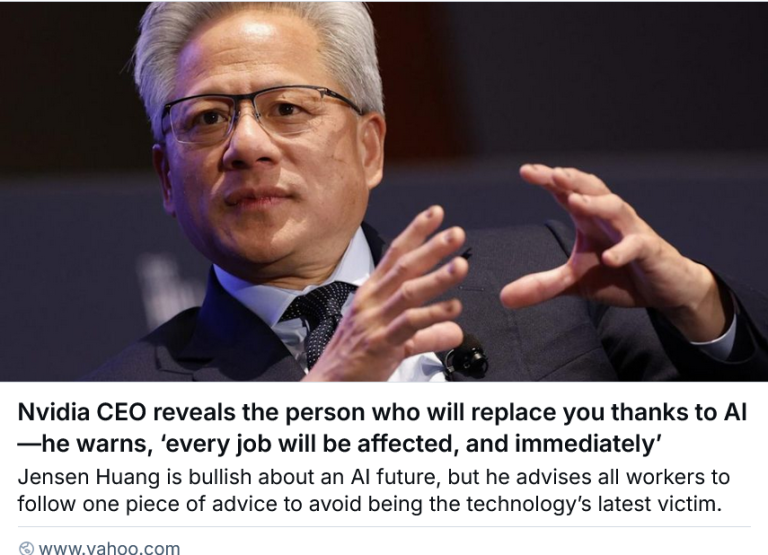
Huang’s view is often summed up this way: AI itself may not remove you from your job, but a person who uses it better might take your place. That is a serious warning, but it is also useful.
It means you still have control. You can learn the tools, practice better prompts, check the results, and become the person others rely on.
The Career Shift Huang Is Pointing To
From “doing tasks” to “directing work”
In the past, many jobs rewarded people for doing the same task again and again. Now, more value may go to people who can guide smart tools, judge quality, and connect ideas.
For example, a marketer may use AI to draft ad ideas, but the human still decides which idea fits the brand. A software worker may use code helpers, but the human still checks security, logic, and user needs.
One skill now cuts across many careers
The important skill is not only “knowing AI.” It is knowing how to use AI inside your own field. A nurse, lawyer, accountant, mechanic, or student can all benefit in different ways.
If you are just starting, build a base with practical skills first. A helpful place to begin is 9 Smart AI Skills That Can Move You From Beginner to Better Jobs, especially if you want a simple path from basic use to stronger workplace value.
What This Means for Different Workers
| Worker Type | Best Move Now | Main Risk |
|---|---|---|
| Office worker | Use AI for drafts, summaries, reports, and research checks | Doing routine work slowly |
| Student or new graduate | Learn AI tools plus one strong subject area | Only learning tools, not real judgment |
| Manager | Use AI to improve planning, hiring, training, and communication | Ignoring how teams actually work |
| Creative worker | Use AI for rough ideas, then add taste and human insight | Publishing average work with no point of view |

5 Smart Moves to Use Huang’s Advice This Week
1. List the boring parts of your job
Start with the work that drains your time. This could be meeting notes, first drafts, email replies, basic research, spreadsheet cleanup, or status updates.
These are the places where AI can give you time back. Do not start with your hardest task. Start with the repeatable task.
2. Pick two tools and use them daily
You do not need twenty apps. Choose one general assistant and one tool made for your work, such as writing, coding, design, data, or study.
If you want ideas, compare options in 11 Best AI Productivity Tools in 2026 for Work, Study, and Software Teams. The goal is not to collect tools. The goal is to build a habit.
3. Learn to ask better questions
Better input gives better output. Instead of asking, “Write a report,” give context, audience, goal, format, and limits.
For example, say who the report is for, what decision it should support, and what tone it needs. Prompting is becoming a workplace language.
4. Check everything before you trust it
AI can be fast and still be wrong. It can miss context, invent details, or sound confident about weak answers.
This is where your value grows. The worker who can review, edit, fact-check, and improve the output becomes more useful, not less.
5. Connect AI to a real business result
Your boss may not care that you used a new tool. Your boss cares if you saved four hours, found a customer problem, improved a report, or helped the team move faster.
Keep a small record of wins. Write down time saved, errors reduced, ideas created, or projects completed faster.
What Jobs Are More Likely to Stay Strong?
Jobs with trust, judgment, and human contact
Many people ask which jobs will survive AI. No one can promise a perfect list, but some roles have stronger protection because they need trust, care, judgment, or physical presence.
Examples include health care, skilled trades, leadership, teaching, engineering, research, sales, and creative direction. But even in these fields, workers who use AI will likely move faster.
Jobs that mix domain skill with technology
The safest path is not hiding from AI. It is combining it with something useful: finance, medicine, law, operations, design, logistics, manufacturing, or customer support.
This is also why smart devices, cameras, and automation are changing many industries beyond office work. Even home security is being reshaped by smarter systems, as shown in 7 Best Smart Home Security Systems 2026: AI-Powered Cameras vs Traditional Monitoring.

FAQ
What is Jensen Huang’s main AI job advice?
His message is to learn how to use AI instead of fearing it. The bigger danger is letting other people become faster, sharper, and more productive while you stay still.
Does Jensen Huang think AI will cause layoffs?
His public advice focuses more on adaptation than fear. He suggests that workers should understand the purpose of their jobs and use new tools to do that work better.
What career path may do well in the AI era?
Careers that combine strong subject knowledge with AI skills may do well. This includes technical fields, business roles, health care, science, design, and operations.
What is Jensen Huang’s net worth?
His net worth changes often because much of it is tied to Nvidia’s stock price. For the latest number, check a live financial source, since it can move a lot with the market.
Do I need to become a programmer to stay safe?
No. Coding can help, but it is not the only path. You can also learn how to use AI for writing, planning, research, customer work, analysis, design, and decision support.
Final Recommendation
Take Jensen Huang’s advice as a direct career warning and a clear chance. Do not wait for your company, school, or manager to train you.
Choose one part of your work, apply AI to it this week, and measure the result. The best career move now is simple: become the person who knows the work and knows how to use the newest tools to do it better.
“Choose one part of your work, apply AI to it this week, and measure the result.”
*Affiliate link — we may earn a small commission at no extra cost to you.

Career growth columnist and industry observer. Writes about salary negotiations, job market trends, and upskilling for India's emerging workforce.