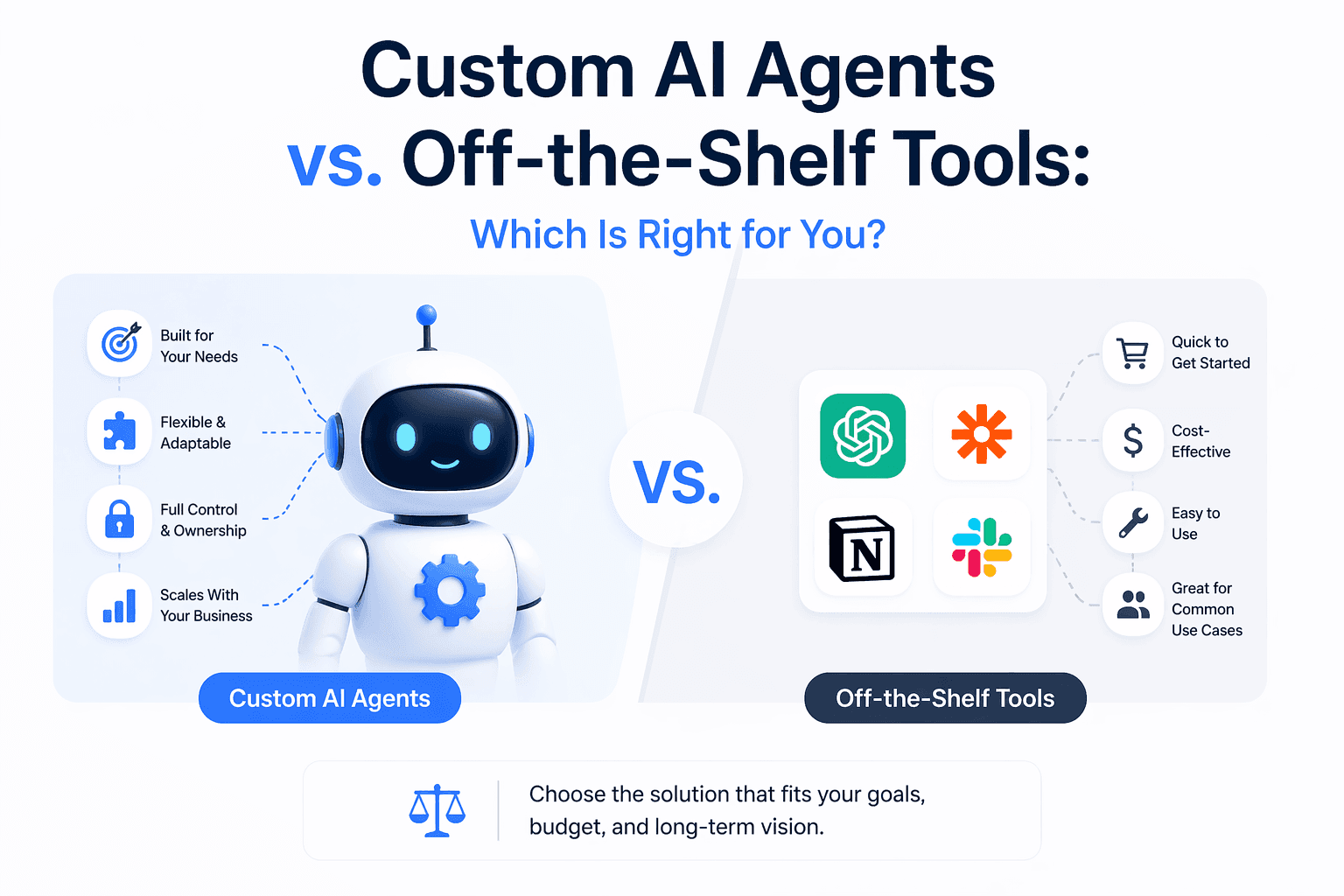
Customer service teams are under pressure to do something fast with automation, but the wrong choice can quietly create more tickets, more escalations, and more frustrated customers. The real question is not “Should we use agents?” It is whether you should buy a ready-made customer service agent or build a custom GPT-5.5-powered solution around your business workflows.
What Is the Real Difference?
A lot of teams use “custom GPT” and “AI agent” like they mean the same thing. They do not.
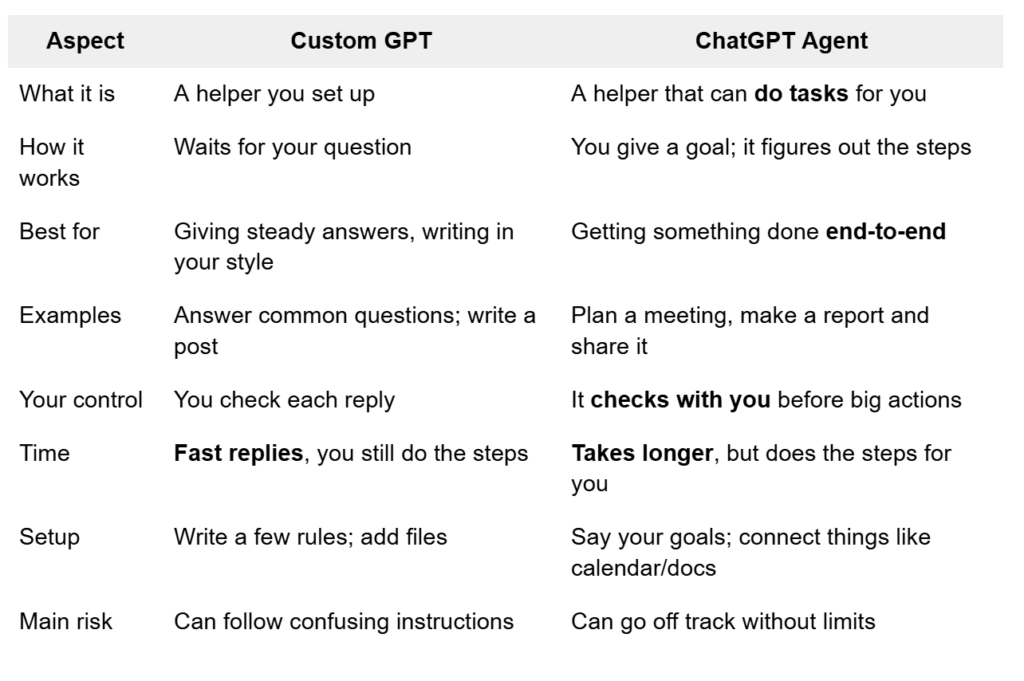
A custom GPT is usually a specialized assistant designed to answer questions, interpret information, follow structured instructions, and guide users. It is often best as a reference tool: “What should I do?” or “How do I handle this policy?”
An AI agent goes further. It can take action across systems: update an order, issue a refund, create a ticket, trigger a workflow, check a CRM record, or escalate a case based on business rules. In simple terms: people consult a custom GPT, but they delegate work to an AI agent.
When you add GPT-5.5-level capabilities into the mix, custom solutions can become much more powerful: better reasoning, stronger coding and data workflow support, more sophisticated automation, and improved handling of messy customer interactions. But more power also means more design responsibility.

Ready-Made AI Agents: Best When You Need Speed
Ready-made customer service agents are prebuilt platforms designed for common support use cases. They usually plug into help desks, chat widgets, knowledge bases, CRMs, and customer messaging tools.
Where ready-made agents shine
- Fast launch: You can often pilot in days or weeks, not months.
- Lower technical burden: Your team does not need to architect every workflow from scratch.
- Prebuilt integrations: Many platforms already connect to popular support systems.
- Built-in analytics: Deflection rate, resolution rate, CSAT impact, and escalation tracking are usually included.
- Good for repetitive tickets: Password resets, order status, shipping questions, cancellations, returns, and basic troubleshooting.
If your customer service operation mostly follows standard flows, a ready-made platform can be the practical choice. You get value quickly, avoid heavy engineering overhead, and reduce the risk of overbuilding.
Where ready-made agents struggle
The weakness is flexibility. A ready-made agent may handle “Where is my order?” beautifully, but struggle with nuanced situations like:
- Multi-step refund logic based on customer history
- Industry-specific compliance rules
- Internal tools with no standard integration
- Complex account permissions
- High-value customer exceptions
- Support experiences that need to match a unique brand voice
This is where teams start to feel the ceiling. The tool works, but only inside the box it came in.
Custom GPT-5.5 Solutions: Best When Service Is Strategic
A custom GPT-5.5 solution is built around your data, rules, systems, and service model. Instead of adapting your process to a platform, you design the system around how your business actually works.
This can include a customer-facing agent, an internal support copilot, automated triage, ticket summarization, CRM updates, quality assurance reviews, sentiment detection, knowledge base generation, and workflow execution.
Where custom GPT-5.5 solutions win
- Deeper workflow control: You decide exactly when the system answers, acts, escalates, or asks for approval.
- Better use of proprietary data: Policies, contracts, customer records, product data, and internal documentation can be structured around your needs.
- More complex reasoning: GPT-5.5-style systems can support advanced decision paths, coding tasks, and data workflows.
- Unique customer experience: Tone, escalation logic, personalization, and brand standards can be tightly controlled.
- Competitive advantage: Your support automation becomes part of your operating model, not just another vendor feature.
The biggest advantage is that a custom solution can become more than a chatbot. It can become an operational layer that connects customer conversations to real business actions.
The catch: custom means responsibility
Custom does not automatically mean better. It means you own more of the decisions.
You need to think about:
- Data security and access permissions
- Human approval steps for sensitive actions
- Testing edge cases before launch
- Monitoring hallucinations or incorrect actions
- Fallback paths when systems fail
- Ongoing maintenance as policies change
If you do not have technical resources, strong process owners, or a clear support strategy, a custom build can become expensive and slow.
Ready-Made vs Custom GPT-5.5: Side-by-Side Comparison
| Factor | Ready-Made AI Agent | Custom GPT-5.5 Solution |
|---|---|---|
| Speed to launch | Fast, often days or weeks | Slower, often weeks or months |
| Cost structure | Lower upfront, recurring platform fees | Higher upfront, flexible long-term economics |
| Customization | Limited to platform capabilities | Highly tailored to workflows and systems |
| Best for | Common support tasks and standard workflows | Complex, regulated, or differentiated service models |
| Integrations | Prebuilt connectors | Custom APIs and deeper system orchestration |
| Control | Moderate | High |
| Risk | Vendor lock-in and feature limitations | Build complexity and maintenance burden |
How to Choose the Right Approach
Here is the simplest way to decide.
Choose a ready-made AI agent if:
- You need results quickly
- Your tickets are repetitive and predictable
- Your support stack is already supported by major platforms
- You do not have engineering resources available
- You are testing automation for the first time
- Your main goal is reducing ticket volume
For many teams, this is the smartest starting point. You can learn what customers ask, measure automation impact, and identify which workflows deserve deeper investment later.
Choose a custom GPT-5.5 solution if:
- Your workflows are too specific for off-the-shelf tools
- You need the agent to take actions across multiple internal systems
- You operate in a regulated or high-risk environment
- Your service experience is a major brand differentiator
- You want to automate internal support operations, not just customer chat
- You have proprietary data that creates a real advantage
If support is central to retention, revenue, or compliance, custom is often worth the extra effort.

The Hybrid Approach Is Often the Smartest
You do not have to pick only one. Many strong customer service teams use a hybrid model:
- Start with a ready-made agent for common front-line questions.
- Add a custom internal GPT to help agents find policies, draft replies, and summarize tickets.
- Build custom GPT-5.5 workflows for high-value or complex processes.
- Connect systems gradually instead of automating everything at once.
- Use human approvals before allowing sensitive actions like refunds, cancellations, or account changes.
This approach gives you speed without giving up long-term control. It also reduces risk because you can prove value before investing in deeper automation.
The Biggest Mistake Teams Make
The biggest mistake is buying or building before mapping the work.
Before choosing any solution, document your top 20 support workflows. For each one, ask:
- Can this be answered from existing knowledge?
- Does it require customer-specific data?
- Does it require action in another system?
- What is the risk if the wrong action happens?
- Should the agent act automatically or ask for human approval?
This exercise makes the decision much clearer. If most workflows are simple Q&A, ready-made is probably enough. If many workflows require judgment, data lookup, and system action, you are looking at a custom agent architecture.
FAQ
1. Is a custom GPT the same as an AI agent?
No. A custom GPT usually provides answers, guidance, or structured information. An AI agent can go further by taking actions across systems, such as updating records, creating tickets, or triggering workflows.
2. Are ready-made AI agents good enough for customer service?
Yes, for many teams. They are especially useful for repetitive questions, simple account support, order tracking, returns, and standard troubleshooting. They may not be enough for complex or highly customized operations.
3. When does a custom GPT-5.5 solution make sense?
It makes sense when your support workflows require advanced reasoning, proprietary data, deep integrations, strict compliance, or a highly differentiated customer experience.
4. Is custom always more expensive?
Custom usually costs more upfront, but it can be more efficient long term if it automates valuable workflows, reduces manual work, and avoids the limitations of platform pricing or vendor lock-in.
5. Should customer service agents fully automate refunds and account changes?
Not at first. Sensitive actions should usually include approval steps, limits, audit logs, and escalation rules. Automation should earn trust before it gets full control.
Final Recommendation
If you are early in your automation journey, start with a ready-made AI agent for simple, high-volume support tasks. It is faster, easier to manage, and gives you real data about where automation helps.
If your customer service operation is complex, regulated, deeply integrated, or strategically important, invest in a custom GPT-5.5 solution. The best long-term setup is often hybrid: use ready-made tools for speed, then build custom agent workflows where control, intelligence, and differentiation matter most.